To Explain the World: The Discovery of Modern Science
| Authors | Weinberg, Steven |
| Tags | Science Ancient, Science -- Greece -- History, Science Medieval, Science -- History, Science -- Methodology -- History, Sciences anciennes, Sciences -- Grèce -- Histoire, Sciences médiévales, Sciences -- Histoire, Sciences -- Méthodologie -- Histoire, SCIENCE -- General, HISTORY -- General, Science, Science -- Methodology |
| Publisher | HarperCollins Publishers |
| Published | 16 feb 2015 |
| Date | 26 nov 2022 |
| Languages | eng |
| Identifiers | oclc: 903376149, Amazon.com, isbn: 9780062346650 |
Description
cf. Hannam's God’s Philosophers: How the Medieval World Laid the Foundations of Modern Science
contains a ref. to the interesting, neglected-and-unprinted (like Galileo's letter to Rinuccini) "relational mechanics" Proposition 43, Theorem 22, of Newton's Principia (ref:24.113):
In an unpublished “Proposition 43” that did not make it into the Principia , Newton acknowledged that Tycho’s theory could be true if some other force besides ordinary gravitation acted on the Sun and planets.22 [G. E. Smith, to be published.]
English transl. is found in Sungenis, Scientific Heresies and Their Effect on the Church: A Critique of: "The Realist Guide to Religion and Science" p. 17 (Latin transcription p. 407n470):
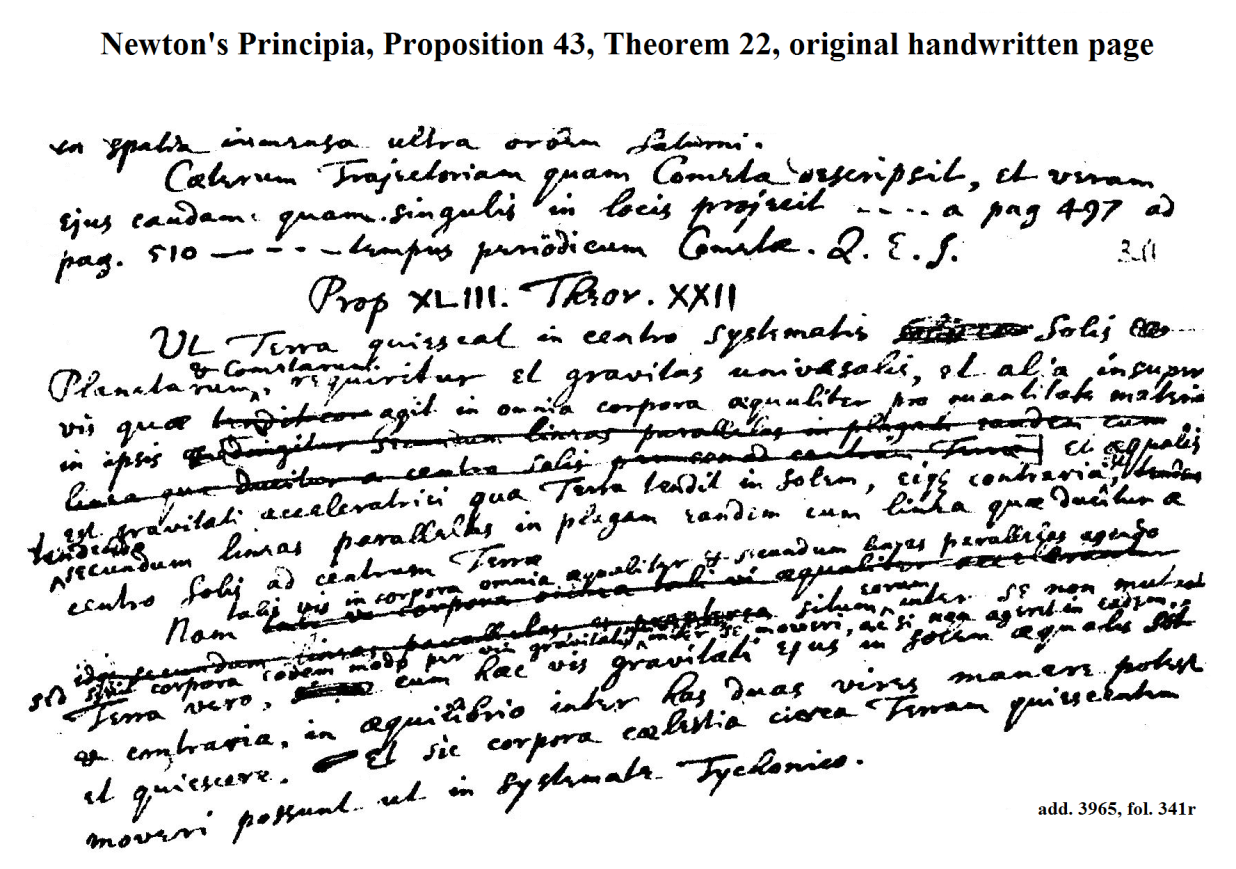
Ut Terra quiescat in centro Systematis Solis Planetarum & Cometarum, requiritur et gravitas universalis, et alia insuper vis quæ agit in omnia coropora æqualiter pro quantitate materiæ in ipsis et æqualis est gravitati acceleratrici qua Terra tendit in Solem, eique contraria est, tendendo secundum lineas parallelas in plagam eandem cum linea quæ ducitur a centro Solis ad centrum Terræ…Nam talis vis in corpora omnia æqualiter & secundum lineas parallelas agendo situm eorum inter se non mutat sed sinit corpora eodem modo per vim gravitatis universalis inter se moveri, ac si non ageret in eadem. Terra vero, cum hæc vis gravitati ejus in Solem æqualis sit & contraria, in æquilibrio inter has duas vires manere potest et quiescere. Et sic corpora cælestia circa Terram quiescentem moveri possunt ut in Systemate Tychonico.
In order for the Earth to be at rest in the center of the system of the Sun, Planets, and Comets, there is required both universal gravity and another force in addition that acts on all bodies equally according to the quantity of matter in each of them and is equal and opposite to the accelerative gravity with which the Earth tends to the Sun. For, such a force, acting on all bodies equally and along parallel lines, does not change their position among themselves, and permits bodies to move among themselves through the force of universal gravity in the same way as if it were not acting on them. Since this force is equal and opposite to its gravity toward the Sun, the Earth can truly remain in equilibrium between these two forces and be at rest. And thus celestial bodies can move around the Earth at rest, as in the Tychonic system.[40]
Original Latin MSS (add. 3965, fol. 341r) of Principia Proposition 43, Theorem 22 :
cf.: "Why was Principia Proposition 43, Theorem 22 not published?"
In this rich, irreverent, compelling history, Nobel Prize-winning physicist Steven Weinberg takes us from ancient Miletus to medieval Baghdad and Oxford, from Plato's Academy and the Museum of Alexandria to the cathedral school of Chartres and the Royal Society of London. He shows that the scientists of ancient and medieval times not only did not understand what we now know about the world, they did not understand what there is to be understood, or how to learn it. Yet over the centuries, through the struggle to solve such mysteries as the curious apparent backward movement of the planets or the rise and fall of the tides, science eventually emerged as a modern discipline. Along the way, Weinberg examines historic clashes and collaborations between science and the competing spheres of religion, technology, poetry, mathematics, and philosophy.
An illuminating exploration of how we have come to consider and analyze the world around us, To Explain the World is a sweeping, ambitious account of how difficult it was to discover the goals and methods of modern science, and the impact of this discovery on human understanding and development.